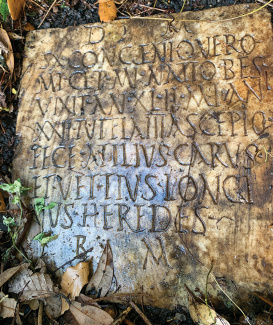
A colleague in the Department of Anthropology referred Santoro to Lusnia, who was both shocked and thrilled by the discovery. With help from Ryan Gray, a University of New Orleans archaeology professor, Lusnia immediately recognized that the inscription looked authentic, as the lettering, phrasing and funerary formula were consistent with genuine Roman gravestones.
Using keywords from the inscription, she searched epigraphic databases and matched it to a second-century marker honoring Sextus Congenius Verus, a Roman sailor.
The stone had once been housed in the Museo Archeologico Nazionale di Civitavecchia, Italy, but was recorded as missing after World War II. It turns out the previous owners of Santoro’s house had inherited the stone from a relative, used it as a garden decoration and forgot it when they moved. They had no idea of its significance.
The artifact is now in the custody of the FBI Art Crimes Team, which will transport it back to the Civitavecchia museum as part of the repatriation process. Lusnia said the museum plans to hold a special event to welcome the artifact back home, and she will attend. She also delivered a paper on the discovery at the annual meeting of the Archaeological Institute of America.
The discovery of such a curious artifact so far from its origins and Lusnia’s scholarly sleuthing soon became international news.
Lusnia fielded one media request after the other, beginning with a local WWL-TV interview at her office. Two days later, the Associated Press interviewed Lusnia in the yard where the artifact was found.
“A bit later, there was a request from the New York Times for a telephone interview, and then an interview with USA Today and a third interview that same day with a reporter at The Times-Picayune,” Lusnia said.
The following week, The Washington Post, the BBC and the Tulane Hullabaloo took their turns interviewing Lusnia. Other outlets covering the story included The Guardian, Smithsonian, NBC News, Fox News and even Popular Mechanics.
From a media standpoint, Lusnia said she is not surprised by all the attention that the artifact has garnered. “I think it’s the mystery and intrigue of the discovery as well as the randomness of it that something Roman would be found in New Orleans,” she said.