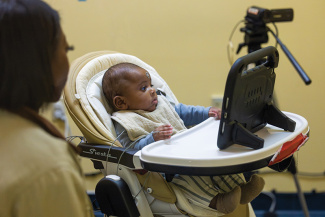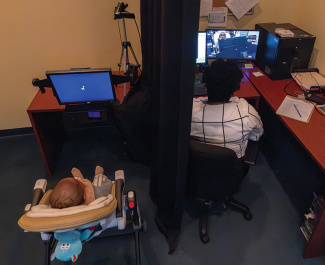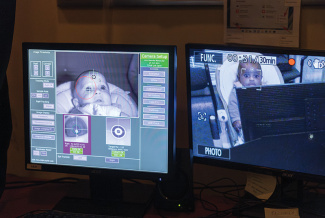

Eight-month-old Joseph sits in a high chair, his tray filled with toys. He reaches for one and looks over at his mother beside him who is smiling and talking softly. He turns back to his toys, unfazed by the camera pointed at him or the researcher sitting behind him.
Joseph is too young to realize this seemingly normal afternoon spent playing with his mother is helping researchers understand how babies pay attention, how they learn and how their relationships shape that process. The information, gleaned from small moments like this, could help children and their caregivers around the world. What researchers learn could influence how caregivers, clinicians and educators support children during one of the fastest periods of brain development in their lives.
Joseph and his mother are part of a study being conducted by the Learning and Brain Development Lab at Tulane University, led by Julie Markant, associate professor of psychology in the School of Science and Engineering. The study, funded by a $1.9 million grant from the National Institutes of Health, examines how caregivers affect an infant’s ability to focus and control their attention during the first year of life.
The research could help explain fundamental science about how brains work from the very beginning. By understanding how attention develops at its earliest stages, researchers can better explain how more complex skills — like learning, emotional regulation and social interaction — emerge over time.
They can also obtain insights into how best to care for infants and give them the best start in life. Once there is a baseline of research examining these processes in typical development, researchers can also study atypical development, such as autism spectrum disorder. Without a clear picture of typical development, it is difficult to identify early signs or design effective early interventions for atypical development.