Murray tapped into Tulane’s innovation ecosystem to jump-start Exactics with her co-founders. In October 2024, she entered the Tulane Innovation Institute’s Open Medical Innovation Challenge (OPEN MIC) Night and the Albert Lepage Center for Entrepreneurship and Innovation Pitch Friday Competition, earning $2,500 in prize money. By spring 2025, she advanced in the Pitch Friday Series Grand Prize Round and the Tulane Business Model Competition, securing a combined $45,000.
“What’s awesome about Tulane students — and Dylan in particular — is that they’re curious. And when curiosity meets a program at Tulane, it can really turn into something pretty special,” said Kimberly Gramm, David and Marion Mussafer Chief Innovation & Entrepreneurship Officer at the Innovation Institute.
Murray also connected with Monica Embers, an internationally renowned Lyme disease researcher at Tulane, who is helping validate the test at the Tulane National Biomedical Research Center at its Covington, Louisiana, campus.
Tulane Ventures, an early-stage investment fund launched by the Innovation Institute, has invested $250,000 in Exactics, enabling the company to continue development and bring the test to market.
The TiCK Test is powered by Exactics’ patented Proteus+ platform, a modular system designed to be adapted to detect hundreds of other infectious diseases by simply swapping biomarkers.
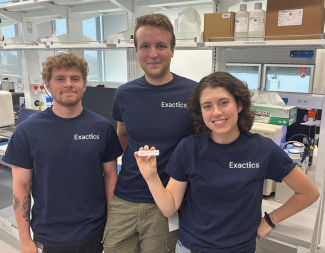
The idea began with CEO Julian Kage, who developed the core technology after witnessing a friend become seriously ill from Lyme disease. Kage and Murray first met as freshman lab partners. The two stayed in touch, and Kage later invited her to help commercialize the technology alongside co-founders Sean Greeby, Max Almeida and Zachary Sarmoen.
“Dylan’s entrepreneurial spirit is a strong example of the potential we are seeing in student-led innovation across Tulane University,” Gramm said. “Exactics has quickly gained traction and the potential to scale.” Earlier this year, the startup made history as the first team to win both the College and Social New Venture Challenges at the University of Chicago, securing $250,000 in prizes.
Exactics has mapped out an initial market-entry strategy targeting the pet and veterinary markets through a licensing deal with Tick Solutions Global, the inventors of the TiCK MiTT. A 2026 launch is planned in major pet health and outdoor retailers, with a human version of the TiCK Test to follow pending regulatory approval.