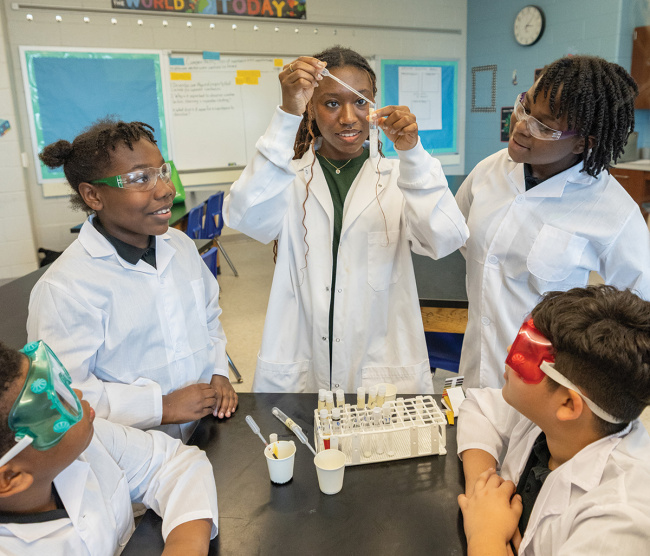
Students in lab coats doing a science experiment with pipettes and test tubes.

Tulane student Nemat Iddisah, center, leads an interactive chemistry and forensics lesson with fifth graders from Esperanza Middle School as part of a service-learning project with the Tulane School of Science and Engineering. Photo by Kenny Lass

For One’s Own

From finance and engineering to theater and AI, students partner with nonprofits to turn coursework into community change.

Donning lab coats, goggles and gloves, fifth graders at Esperanza Middle School had a mystery on their hands. They had to figure out how one of their classmates became ill after eating a cookie at lunch.

It was all part the fictional “Case of the Poisoned Cookie,” a hands-on forensics lesson led by four Tulane University science students as part of Tulane’s STEM program in partnership with the Tulane Center for Public Service. Playing the role of investigators, the Esperanza students performed simple tests using substances such as vinegar, iodine and water to identify a strange powder that had been detected on the cookie crumbs.

Similar scenes play out almost daily as Tulane students leave campus to fulfill service-learning hours and, in the process, make a difference in the city they call home. Equipped with knowledge they gained in Tulane’s classrooms, lecture halls and research labs, they head to community gardens, public schools, hospitals, arts centers and other venues, where they put their education to work in ways that matter.

They teach financial literacy to high school students. They prepare young music students for community performances. They design assistive technology devices for people with disabilities. They take water samples to monitor the health of the water ecology system. They provide consulting services to nonprofits.

A post-Katrina commitment

Tulane’s academic service-learning program is based upon a collaborative partnership between the university and the community. Service learning has been front and center in the Tulane landscape since the fall semester of 2006 when Tulane’s leadership launched the Center for Public Service (CPS) as part of the university’s post-Hurricane Katrina Renewal Plan.

By including community engagement in the plan, Tulane became the first major private research university in the nation to make public service a graduation requirement. Nearly two decades later, what began as a bold experiment has since become one of Tulane’s most enduring — and endearing — legacies.

While Tulane students have been engaged in volunteer work since the university’s founding in 1834, the launch of CPS following Hurricane Katrina formalized Tulane’s long-standing commitment to community engagement and embedded it within the academic mission of the institution along with the school’s motto “not for oneself, but for one’s own.”

University leaders say this shift reshaped not only how Tulanians learn but also how they show up for their city.

“It created both an infrastructure and the strategic leadership that allowed this work to diffuse through the entire campus, giving it a depth and breadth and visibility that has been central in creating the Tulane of today,” said Senior Vice President for Academic Affairs and Provost Robin Forman.

“Tulane remains one of the nation’s most community-engaged universities, a status affirmed by its Carnegie Foundation’s Community Engagement Classification, the gold standard for civic engagement in higher education,” he said.

The center at work

CPS Executive Director Agnieszka Nance has been part of the center since mid 2007 when she joined the staff as an assistant director after a two-year stint as a German language professor in the School of Liberal Arts. Since then, she has seen the center evolve into a major facet of Tulane’s undergraduate experience, offering a range of programs that include public service internships, civic engagement fellowships and advocacy opportunities.

In addition, the center offers a Peace Corps Prep course for students interested in post-graduate service, and an annual Day of Service.

“When the university was restructuring after Katrina, there was a collective decision to create a hub for community engagement,” Nance said. “It continues to be very bold and almost revolutionary in higher education to make it a requirement for all undergraduate students.

“It continues to be very bold and almost revolutionary in higher education to make it a requirement for all undergraduate students.”

Agnieszka Nance, CPS Executive Director

“It’s now part of our DNA. It’s a transformative experience for our students who gain valuable skills in empathy, leadership and critical thinking but also a tangible skill set that can help them in their careers.”

Behind the scenes, Nance leads a dedicated team of 18 staff members who keep the center running smoothly. They include Bridget Smith, assistant director for Academic Community Engagement. Smith works with faculty in developing service-learning opportunities, and she oversees such logistical issues as scheduling, transportation and accessibility accommodations.

“Our roles can vary from being a thought partner on syllabus design or reflection strategies to logistical support and project management, ensuring we’re meeting both our community partners’ goals and the class objectives,” Smith said. “We support students with any challenges while helping them develop their own civic identity.”

A college student helps a child in a lab coat and goggles with a science experiment.

Haley Duhe assists students during the hands-on activity.

Service learning in action

Those efforts come to life in places like Esperanza Middle School, where sophomore Nemat Iddisah and three Tulane classmates circulated among teams of fifth graders, making sure everyone understood the steps in the forensics experiment. The room buzzed with delight as children poured, mixed, observed and recorded their findings, eager to determine the source of the “poison” discovered on the cookie crumbs.

“I love getting to bring science into classrooms and watching students light up when they make discoveries for themselves,” said Iddisah, who is majoring in neuroscience and cognitive studies in the School of Science and Engineering. “It brings back the feelings of wonder and excitement I had for science when I was little.”

For Iddisah, the value of service learning goes beyond her passion for science. It lies in the impact she and other Tulane students have had on the New Orleans community.

“We often focus on what the city can do for us and take advantage of it without thinking about how we can give back to this beautiful place,” she said. “So although service learning is a chance to share knowledge and provide support, it’s also a chance to learn from the kids, teachers and neighborhoods that make New Orleans so special.”
Those are the kinds of words that Tulane alumna Michelle Hewlett Sanchez, a senior professor of practice and director of the Tulane Center for K-12 STEM Education in the School of Science and Engineering, hears on a regular basis as students head out into the community to fulfill service-learning hours.

“It has transformed the experience that undergraduates have at Tulane,” said Sanchez. “It also attracts the kind of students who believe in the community service aspect of the curriculum. It puts them in situations where they have to get out of their comfort zone. It makes them more communicative and more understanding of people who may have different backgrounds than they do.”

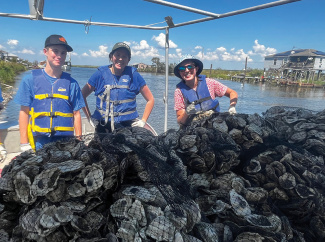
That transformation is evident in the wide range of projects that have unfolded on campus, everything from an A. B. Freeman School of Business initiative that teaches personal finance and investment skills to high school students to a School of Science and Engineering partnership that addresses such issues as coastal erosion and storm recovery in the tribal communities of southeast Louisiana.

At the School of Architecture and Built Environment, Professor of Practice Patti Dunn is partnering with the recycling nonprofit RicRACK to bring sustainability to Carnival season through the service-learning component of her textile design course.

“Students are tackling the challenge of textile waste by creating Mardi Gras throws from recycled materials, learning how design can address environmental challenges while celebrating New Orleans culture,” Dunn said. “It’s a creative approach to making a meaningful community impact.”

Woman in orange talks to students in a classroom with design charts on the wall.

Patti Dunn, a design professor in the School of Architecture and Built Environment, meets with students to discuss ideas for environmentally friendly Mardi Gras throws. Photo by Erin Chadwick

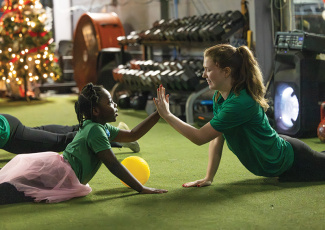
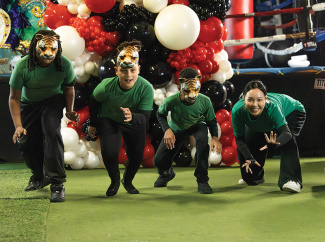
Through the School of Liberal Arts’ Department of Theatre and Dance, students spent the fall semester helping young actors stage an environment-themed production called “Animal Crackers.” The children were part of Cultivating Youth, a nonprofit group that addresses childhood trauma.

At Tulane’s Schwartz Family Center for Experiential Business Learning in partnership with First Generation Investors (FGI), Tulane finance majors teach personal finance and investment skills to high school students. Students who complete the program are awarded $100 by FGI to invest in a carefully selected set of investment funds. Upon graduating from high school and turning 18, the money is theirs to continue to manage.

“This is true service learning,” said Mara Baumgarten Force, director of the Schwartz Family Center for Experiential Learning and the Seymour S. Goodman Professor of Business Administration. “Tulane students put their new skills into immediate practice with the high schoolers. The goal is for the high schoolers to be able to present a capstone presentation on how they would invest a hypothetical portfolio.”

At a recent presentation at the Goldring/Woldenberg Business Complex on Tulane’s uptown campus, students from Rooted School New Orleans showed off what they learned during the eight-week program, from how to determine riskiness in choosing stocks to where to look for investment advice.

Juan Carlos Cotes thanked his Tulane tutor Sydney Horn and other teachers involved in the program for “teaching me how to invest in my future and become financially secure.” Horn said it was a pleasure working with Juan.

“Juan’s drive to learn the material and understand investing showed his passion to pursue business,” she said. “The program teaches these high schoolers ways to save and invest their money that they likely did not know about before.”
Since 2020, computer scientists and AI experts Nick Mattei and Aron Culotta  of the Tulane Center for Community-Engaged AI have supervised more than 50 students on 15 projects with nine community partners.

Students are also working with the nonprofit resources center Families Helping Families to develop a chatbot tool to enable easier access to information for parents of children with disabilities.

Young girl in pink tutu high-fives woman on a mat in a gym.
Four people in green shirts, three with tiger masks, crouch on a green floor.

Students from Tulane’s Theatre and Dance Department spent the fall semester helping young actors from the nonprofit group Cultivating Youth stage an environment-themed production called “Animal Crackers.” Photos by Kenny Lass

An ethos that endures

Katherine Raymond (SSE ’99, SLA ’07), a senior professor of practice in biomedical engineering in the School of Science and Engineering, has led a wide array of service-learning projects, including her partnership with the nonprofit group MakeGood to design and produce mobility trainers to help youngsters with physical disabilities build independence and strength as they prepare for real wheelchairs.

A Tulane graduate student when Katrina devastated New Orleans, Raymond recalls the excitement around campus when students learned of the decision to make service learning an academic requirement.

“No one fully understood which students would enroll after Katrina. But what seemed to happen is that the obligation to be part of the rebuilding of the city attracted students that wanted to make a difference. And I think we still attract that type of student at Tulane — engaged, creative, driven to have a larger impact in the world.

“It became part of our ethos, that we aren’t just a great place to learn, but a great place to act,” Raymond said. “Tulane students don’t sit in classrooms and receive information — they bring ideas to faculty, they try novel things, they create innovative designs, new initiatives and programs.
“It gave Tulane students permission to be part of not just New Orleans, but of Tulane’s post-Katrina identity.  And that continues today, with our students shaping what impact is possible with their passion and inventiveness.”

Volunteers in a boat and water work under a sunny sky.
Three people in life vests on a boat loaded with oysters, a sunny bay behind.

Tulane students work on a coastal restoration project using oyster shells as part of a service-learning project called “Indian Tribes on the Bayou” in Port Sulphur, Louisiana. Photos by Laura Kelley

Service beyond graduation

For many students, that commitment doesn’t end when they receive their diplomas. Through the CPS’s Young Alumni Action Council, recent graduates like Tess Rebold (SLA ’21) and Sophie Glynn (SLA ’21) continue to stay engaged in their communities, while also helping raise money to make the center even stronger.

“It’s taught me what civic duty really means,” said Rebold. “It means staying accountable, showing up and finding ways to keep making an impact long after graduating from Tulane.”

Glynn said she is forever grateful to what she learned through CPS.

“Tulane wasn’t just four years of learning; it became a foundation for a lifetime of engagement and purpose,” Glynn said. “I owe a great deal of my continued connection to New Orleans and to the communities I’ve become part of since to CPS and the values it instilled.”
“It’s taught me what civic duty really means. It means staying accountable, showing up and finding ways to keep making an impact long after graduating from Tulane.”
Tess Rebold (SLA ’21)

Tags