photo grid with a cotton plant, microscope view of cross section of a cell, aerial view of Louisiana wooded area, soybean, magnolia, and blue sky

From Uptown to Downtown to Small Towns: The Rural Reach of Tulane Researchers

From cancer treatment to earthquake monitoring, the impact of Tulane research extends far beyond the city of New Orleans into rural areas in the South and around the country.

Coushatta, Louisiana, is more than 250 miles from Tulane’s uptown campus. But when a series of earthquakes — including the largest inland temblor ever recorded in the state — struck the area in late 2025 and early 2026, a Tulane professor traveled from Walter E. Blessey Hall on the uptown campus to the Coushatta area to download data critical to assisting fellow Louisianians.

Cynthia Ebinger, Marshall-Heape Chair in Geology in the School of Science and Engineering, is one of many Tulane University researchers whose work extends beyond the university and the city of New Orleans. Faculty members throughout the university are working with rural communities in Louisiana and around the country, using their expertise and discoveries to improve lives.

Ebinger, a geoscientist internationally recognized for her research on earthquakes and a recent inductee into the National Academy of Sciences and the American Academy of Arts and Sciences, has installed earthquake monitoring equipment in northwestern Louisiana, including Coushatta, to record earthquake signals and work to better understand the source of the earthquakes that rattled that corner of the state. Researchers can also use the data gathered from this equipment to understand earthquakes around the world.

This equipment will not only give insight to researchers on the cause of the Coushatta earthquakes, it will also inform hazard assessments and future building plans for the area.

“Those instruments measure vertical and horizontal ground motions so small they can’t be detected at the surface,” Ebinger said. “Our goal was to establish a baseline for earthquake activity to inform state planners and to better understand Louisiana’s subsurface structure.”

Smiling woman in glasses and colorful floral blouse, arms crossed, outdoors with green foliage.

Cynthia Ebinger. Photo: Kenny Lass

Split image: Circular patterns in sand; two researchers setting up field equipment.

Left to right: Small “sand volcanoes” formed in soft sediments near Coushatta, Louisiana, after earthquakes shook water-saturated ground, causing sand and water to bubble up to the surface. Engineers from the U.S. Geological Survey’s Albuquerque National Seismic Laboratory worked with Ebinger to install a seismometer and accelerometer near Coushatta. Photos: Cynthia Ebinger

Connecting with rural communities

For Marcus Coleman, a professor of practice in economics and in the Strategy, Leadership and Analytics Minor program in the School of Liberal Arts, the most important element to successfully working with rural communities is collaboration.

Coleman grew up in the rural Mississippi River Delta region of Louisiana, where he saw firsthand how food systems, which include food production, processing, distribution, consumption and waste management, can fail rural communities.

He now brings agricultural research and leadership training to people working to make positive change in the food systems of their own communities. He says a big part of his job is listening to people and understanding their needs.

He remembers this when he attends community meetings around the state to share the most up-to-date research from academia — research that will empower communities to support each other through times of food insecurity and changes brought on by technology.  For example, when residents of a small town can no longer depend on agriculture as a source of income, Coleman works to share other employment options with them.

“When I initially engage, I’m always going to hang out in the back of the room. I’m never going to come in like I’m the expert until I’m invited to do so,” Coleman said. “I may have a PhD, but that person [in the community] has a PhD in knowledge of the community that I don’t have. I need that knowledge for me to help them. I need them to trust me.”

Smiling man with glasses and beard in a blue plaid shirt at a table.

Marcus Coleman. Photo: Kenny Lass

One of the projects Coleman has worked on in rural communities is The Next California, an initiative of the World Wildlife Fund that aims to bring food crops that have long been grown in California to other areas, like the Mississippi Delta region. Doing so can improve the country’s food security and build a more climate-resilient food system in areas of the nation experiencing warmer, drier growing seasons.

The Next California project requires talking to Mississippi Delta farmers to understand what they would need to start growing more fruits and vegetables in place of the larger staple crops such as rice and corn that dominate agriculture in the region today, Coleman said.

Through community workshops that teach supply and demand and other economic concepts, Coleman also encourages the establishment of farmers markets and grocery stores that can improve both the public health and economy of rural towns.

Understanding the needs

Many of the societal problems typically associated with large cities also impact rural America. The Louisiana Violence Experience (LaVEX) Survey, supported by the Newcomb Institute, looked at rates of violence across the state and what form that violence took. Findings from the LaVEX survey can be used by state policymakers and community leaders to focus resources where they are most needed.

The survey found that gender differences in substance use, a contributing factor to high rates of violence, are more pronounced in rural Louisiana, where men are more than twice as likely as women to report binge alcohol use and nearly three times as likely to report illicit drug use. It also found that reports of depression or anxiety were more likely in rural than in urban Louisiana.

The institute has already done similar surveys in California, Mississippi and Texas, and they plan to do more across the country.

“We will, for the first time, have a [nationwide violence experience survey] report that will be released this summer,” said Anita Raj, executive director of the Newcomb Institute and Nancy Reeves Dreux Endowed Chair, who was inducted into the National Academy of Medicine in 2025 for her work.

Though urban and rural areas often face the same societal challenges, the solutions to those issues must be tailored to fit the unique needs of each region.

“There are demographic differences and care access differences that can range across parishes and by density of population in parishes; you cannot assume programs that work in urban areas will work or even be made available in rural areas, or for the different populations that may reside there,” said Raj. “If you do not understand the needs, you cannot address them.”

“If you do not understand the needs, you cannot address them.”
Anita Raj

Anita Raj in her office.

Anita Raj. Photo: Sabree Hill

Maternal health

This year, the Newcomb Institute also published a report on access to maternity care in Louisiana that will allow policymakers and community partners to direct resources where they will be most useful. The study found that rural parishes were far more likely than urban areas to have no access to maternity care, including nurses, midwives and obstetricians. Of all the variables the researchers looked at, the population density of a parish was the strongest predictor of the availability of maternity care. Parishes with lower population density had fewer providers.

“We are currently 50th in the nation on women's and children’s health, and there is no possibility of improvement if we continue to lose providers or have parishes with no maternity care available,” said Raj.

The community spirit in the state, however, gives Raj hope that things will improve.

“Louisiana is a wonderful place to work because, while the need is high, the community, clinical and government partners we have are deeply committed to working together to make the state healthier, more health equitable and safer for everyone,” she said.

In addition to studying whether patients have access to maternity care, Tulane is on the front lines of researching how to improve the care that pregnant and postpartum patients receive. The Southern Center for Maternal Health is a center of excellence funded by the National Institutes of Health as part of the Implementing a Maternal health and Pregnancy Outcomes Vision for Everyone (IMPROVE) initiative.

Emily Harville, professor and director of the PhD program in epidemiology in the Celia Scott Weatherhead School of Public Health and Tropical Medicine, is one of the principal investigators of the center. She is a perinatal epidemiologist, which means she studies things that affect pregnancy, birth and neonatal health outcomes. Her current research with the center involves working with hospitals and healthcare providers throughout the state.

One of the main projects Harville is working on tests methods to increase remote monitoring of blood pressure during pregnancy. High blood pressure during pregnancy can lead to serious complications like preeclampsia — a condition that can damage a mother’s organs. Getting patients to track their blood pressure at home enables early detection and management of high blood pressure, reducing the risk of complications.

Smiling woman in blue shirt, standing in front of a downtown building.

Emily Harville. Photo: Kenny Lass

Conducting this research statewide in Louisiana is important, Harville said, because convincing people to participate in a program like remote blood pressure monitoring requires community buy-in, which can vary in different places.

“Even if there are things that we know might have worked more generally, we need to adapt them to the local context as well,” said Harville.

Fifty-plus years in Bogalusa

The Bogalusa Heart Study was started by Tulane in 1973 in the rural town nestled on the Louisiana-Mississippi border and is still ongoing. Discoveries from 53 years of research in Bogalusa have shown that heart disease begins in childhood. Participants say that it is only because of the dedicated researchers and their deep ties in the community that the study has lasted this long.   

Researchers on the Bogalusa team are looking ahead to the next 50 years of the study to investigate cognitive decline and dementia through a $14.5 million grant from the National Institute on Aging. They are also hoping to recruit the next generation of Bogalusa residents, the descendants of that first study’s cohort, to continue it long into the future.   

Harville also works with the Bogalusa Heart Study team, looking at the relationship between cardiovascular disease and pregnancy.

Because the Bogalusa Heart Study is longitudinal, Harville and her team can examine lifelong health impacts among women in the cohort who became pregnant at any point during the study.

The team published a study in March showing that hypertensive diseases of pregnancy are correlated with cardiovascular disease later in life. This study underscored the need for better monitoring of blood pressure post-pregnancy to reduce long-term risk.

State-of-the-art cancer imaging

J. Quincy Brown, the Mark and Diana Tipton Professor of Biomedical Engineering in the School of Science and Engineering, grew up in Columbia, Louisiana, a town with a population of 277. His current work in cancer imaging has the potential to save lives in his hometown and across the globe. Brown is co-lead on a project called MAGIC-SCAN with Brian Summa, associate professor of computer science in the School of Science and Engineering.

Smiling man with short hair and glasses, wearing a light denim shirt. He stands in a bright office with blurred shelves and windows in the background.

J. Quincy Brown. Photo: Kenny Lass

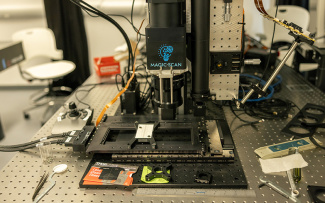
Close up of Magic Scan lab equipment on a lab table

The MAGIC-SCAN tissue scanner, which can rapidly detect cancer cells that would normally need to be painstakingly identified by pathologists using a microscope. Photo: Kenny Lass

In 2024, MAGIC-SCAN received national attention with a presidential visit announcing up to $23 million in funding from the Advanced Research Projects Agency for Health, a bipartisan effort to advance high-impact medical research. MAGIC-SCAN is a tissue scanner that will be enhanced with machine learning in order to detect cancer cells remaining on surgically removed tissue within minutes. This determination is currently a painstaking process that requires pathologists to examine tissue slices under a microscope.   

“Currently, it can take days to weeks before a surgeon knows whether all the tumor has been removed, and our goal is to get that down to 10 minutes, while the patient is still on the table,” said Brown, who was named a 2025 fellow of the National Academy of Inventors. “If successful, our work would transform cancer surgery as we know it.”

“If successful, our work would transform cancer surgery as we know it.”

J. Quincy Brown

Once they perfect the technology, Brown and Summa plan to make the machine affordable for small rural hospitals to purchase and use. With MAGIC-SCAN, patients in the future will be able to access state-of-the-art healthcare, wherever they may live.   

The ongoing work of Tulane researchers in rural Louisiana bolsters the goal of Tulane President Michael A. Fitts to strengthen the bonds between the university and its home state. This commitment includes, among numerous other initiatives, the Louisiana Promise program and the $5.2 billion annual economic impact Tulane has statewide. It also encompasses the university’s plans to create a national hub of research, innovation and destination healthcare in downtown New Orleans — within driving distance of many rural areas.

“Through our cutting-edge research we are creating lifesaving treatments and advancements that benefit all Louisianians,” Fitts said. “We are also ensuring that the best and brightest students stay right here in Louisiana.”